
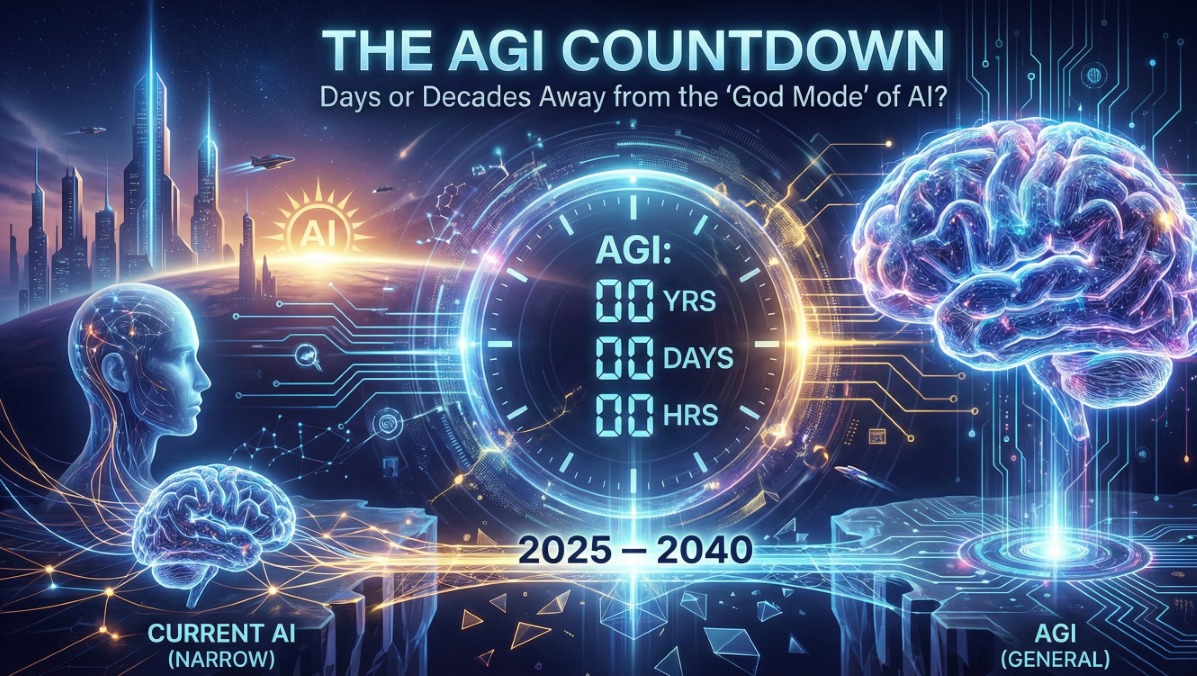
The timeline for Artificial General Intelligence (AGI)—AI that can learn, reason, and perform any intellectual task a human can—has shifted from science fiction to a quarterly earnings call topic. Just a few years ago, the consensus was “maybe 2050.” Today, the world’s leading AI architects are placing their bets on a window that is shockingly close.
Here is the current state of the race to AGI, the conflicting timelines, and what actually stands between us and the finish line.
The Optimists: “It’s practically here” (2025–2029)
The most aggressive timelines come from the people closest to the hardware. The argument here is based on scaling laws: the observation that adding more data and computing power consistently yields smarter models.
Sam Altman (OpenAI): The CEO of OpenAI has been notoriously bullish. In late 2024 and 2025, he suggested AGI could arrive as soon as 2025, or at least within “thousands of days.” His view suggests that we don’t need a magical new invention—we just need to keep scaling up the current technology.
Ray Kurzweil: The famous futurist has held a steady prediction since the late 90s: 2029. Unlike others who adjust their dates based on hype, Kurzweil’s track record gives his consistent prediction significant weight.
Dario Amodei (Anthropic): The leader of the safety-focused lab Anthropic has stated that models could be powerful enough to be transformative within 2-3 years, aligning with the late 2020s window.
The Realists: “We need a new breakthrough” (2030–2040)
The counter-argument is that Large Language Models (LLMs) like GPT-4 are essentially “parrots with good memories.” They can mimic reasoning but lack a true internal model of how the physical world works.
Demis Hassabis (Google DeepMind): Acknowledged as one of the most grounded voices in AI, Hassabis estimates AGI is still 5–10 years away (roughly 2030–2035). He argues that current chatbots lack “world models”—an understanding of cause and effect, physics, and spatial reasoning. Scaling alone, he suggests, won’t solve this; we need architectural breakthroughs.
Expert Consensus: Broader surveys of AI researchers (averaged out) tend to land in the 2032–2040 range. They account for the “last mile” problem: getting an AI from 90% accuracy to 99.99% reliability is exponentially harder than the initial gains.
The “Wall” We Might Hit
Why isn’t everyone agreeing on next Tuesday? There are three major hurdles that could freeze the timeline:
Data Wall: We are running out of high-quality human text to train on. AI companies are now exploring “synthetic data” (AI training AI), but it remains to be seen if this leads to brilliance or “model collapse” (inbreeding of errors).
Energy Crisis: The next generation of data centers requires power equivalent to small nations. Physical infrastructure cannot always move as fast as code.
Reasoning vs. Mimicry: Current AI struggles with long-horizon planning. If you ask an AI to “write a novel,” it creates a great chapter but loses the plot by chapter 10. True AGI needs to maintain a train of thought for days, not seconds.
The Verdict
If you define AGI as “an AI that can pass a bar exam,” we are arguably already there. But if you define it as “an AI that can be dropped into a random office and figure out how to do a job without instructions,” the consensus points to the early 2030s.
Whatever the date, the “Overnight Success” of AGI will likely feel less like a robot uprising and more like a software update—one day, your computer will simply stop waiting for you to tell it what to do.

