
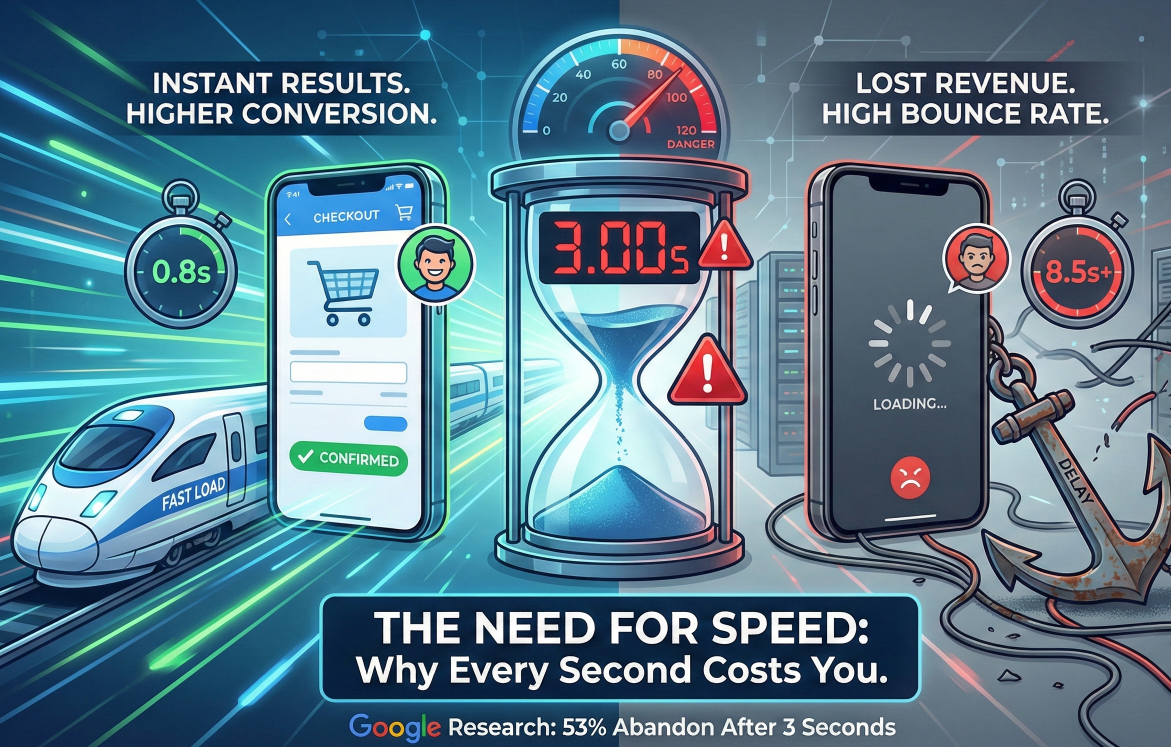
In the digital economy, patience is nonexistent. Here is what Google research reveals about the high cost of a slow-loading digital experience.
Imagine walking into a physical retail store. You approach the counter with an item you want to buy, wallet in hand. But instead of greeting you, the cashier freezes. You wait five seconds. Ten seconds. They just stare blankly.
What do you do? You walk out.
In the digital world, this happens millions of times a day. Your website or mobile app is your storefront. The load time is that cashier. If it freezes, your potential customer is gone — likely into the arms of a faster competitor.
For years, site speed was treated as a technical “nice-to-have,” something for the IT department to worry about. Today, it is perhaps the most critical metric defining your digital success. It is a foundational component of user experience (UX), search engine ranking, and ultimately, your bottom line.
Here is why load time matters more than ever, backed by data from the company that measures the internet: Google.
The Psychology of the “Micro-Moment”
We live in the age of instant gratification. High-speed internet and powerful smartphones have rewired our brains to expect immediate results.
When a user clicks a link, they are entering what Google calls a “micro-moment” — an intent-rich moment when a person turns to a device to act on a need directly. They want to know, go, do, or buy.
If your digital property doesn’t serve that need instantly, you break the moment. Friction is introduced. Frustration mounts rapidly.
The Google Data: The High Cost of Seconds
Google has spent years analyzing the correlation between site speed and user behavior. Their findings are stark and should serve as a wake-up call for any business owner.
The central theme of their research is simple: As page load time goes up, the probability of a user bouncing (leaving immediately) increases dramatically.
According to Google’s research on mobile page speed industry benchmarks, the probability of bounce increases exponentially with every second of delay:
- If page load time increases from 1 second to 3 seconds, bounce probability increases by 32%.
- If it goes from 1 second to 5 seconds, bounce probability increases by 90%.
- If it hits 10 seconds, the probability of bouncing increases by 123%.
Think about that. A mere two-second delay (from 1s to 3s) could cost you nearly a third of your incoming traffic before they even see your offer.
Furthermore, Google’s data has historically shown that 53% of mobile site visits are abandoned if pages take longer than three seconds to load. Three seconds is the new threshold for digital survival.
What You Actually Lose When You Are Slow
The damage goes far beyond just a “bounce rate” statistic in your analytics dashboard. Slow load times trigger a domino effect of negative business outcomes.
1. You Lose Revenue (Conversion Killers)
The most direct impact is financial. If people bounce before the page loads, they cannot buy your product, sign up for your newsletter, or fill out your lead form.
Even a one-second delay in mobile load times can impact conversion rates by up to 20% in retail. In highly competitive sectors like e-commerce or SaaS, speed is often the primary differentiator. If Amazon is faster than you, Amazon wins.
2. You Lose Visibility (The SEO Penalty)
Google wants to provide the best possible experience for its search users. They do not want to send users to slow, frustrating websites.
Google has officially made site speed a ranking factor, most recently through its “Core Web Vitals” initiative. These metrics specifically measure loading performance, interactivity, and visual stability. If your site fails these vitals, you will likely be penalized in search rankings, making it harder for new customers to find you at all.
3. You Lose Brand Integrity and Trust
A slow website feels unprofessional, insecure, and cheap. It signals to the user that you do not value their time.
First impressions are everything. If a user’s first interaction with your brand is staring at a loading spinner, you have started the relationship on a negative footing. Even if they eventually wait for the site to load, they are entering the experience annoyed, making them less likely to convert and less likely to return.
4. The Mobile Multiplier Effect
The stakes are even higher on mobile. Mobile users are often distracted, on-the-go, and relying on cellular networks that might be spotty. Their tolerance for delay is even lower than desktop users.
Given that mobile traffic now accounts for over half of global web traffic, prioritizing mobile load speed is no longer optional — it’s mandatory.
The Verdict: Speed is a Feature
If your website looks beautiful but takes six seconds to load, it is not a beautiful website. It is a broken one.
Businesses must stop viewing performance optimization as a cost and start viewing it as an investment with a massive ROI. Every millisecond you shave off your load time directly improves customer retention, search visibility, and revenue.
In the one-second war for attention, you are either fast, or you are forgotten. Audit your site speed today from https://dotx.info without any cost ; your business depends on it.

