
Introduction: The Dawn of a New Era in App Development
Remember when mobile apps were a novelty, or when a responsive website was a cutting-edge feature? The technology landscape is always shifting, but rarely does it experience an earthquake like the one Generative AI has unleashed. From crafting human-like text to generating stunning visuals and even writing code, Generative AI isn’t just a trend; it’s a fundamental shift, redefining what’s possible in web and mobile app development.
At dotx.info, we’re not just observing this revolution; we’re actively integrating it. We believe that understanding and harnessing Generative AI is no longer optional but essential for any business aiming to stay competitive and deliver truly innovative user experiences.
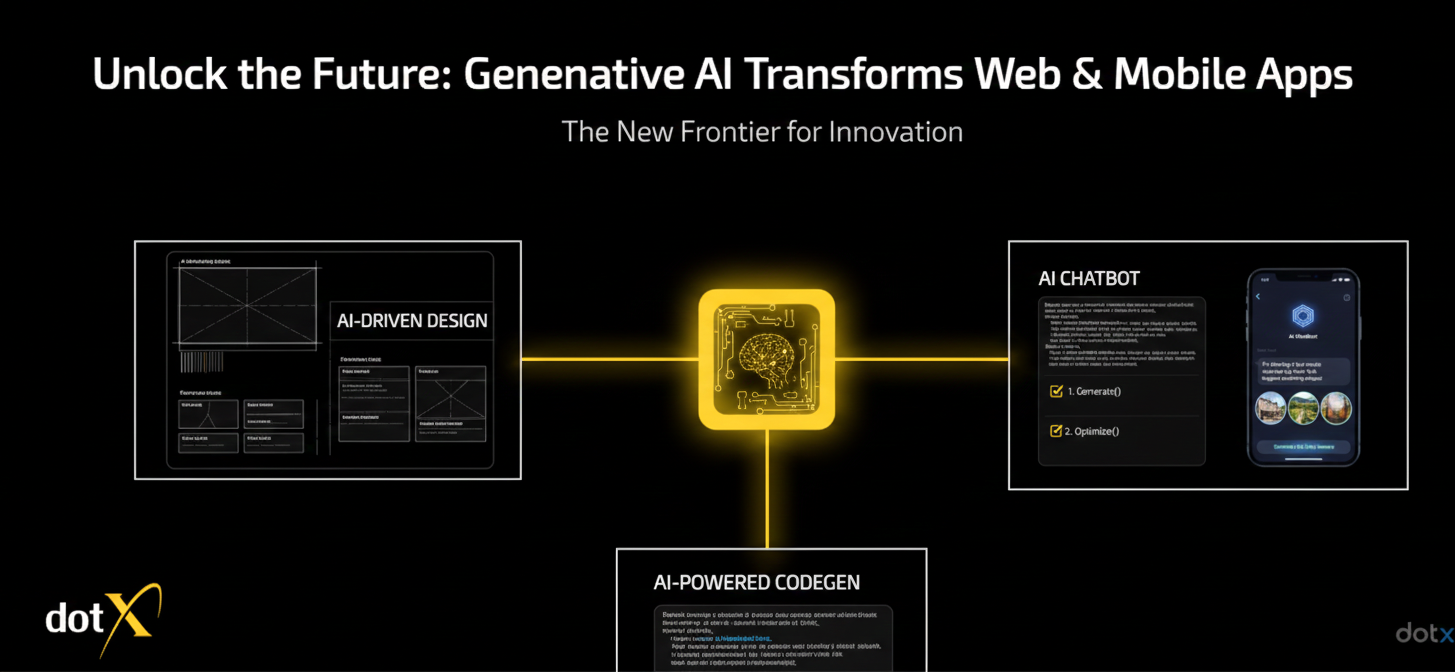
This article will dive deep into how Generative AI is transforming every facet of web and mobile app development – from design and coding to user features and essential security considerations. Are you ready to unlock the future of your applications?
What is Generative AI, and Why Does It Matter for Apps?
Before we explore its impact, let’s clarify. Generative AI refers to AI models capable of producing new, original content rather than just analyzing existing data. Think large language models (LLMs) like OpenAI’s GPT series, image generators like Midjourney or DALL-E, and even code-generating tools like GitHub Copilot.
Why is this critical for web and mobile apps?
Unprecedented Personalization: Create truly unique experiences tailored to individual users.
Accelerated Development Cycles: Automate repetitive tasks, speed up prototyping, and assist with coding.
Enhanced User Engagement: Introduce novel, interactive, and intelligent features.
Cost Efficiency: Streamline processes and reduce manual effort in various stages.
This isn’t just about adding a chatbot; it’s about fundamentally rethinking how apps are built and interact with their users.
1. Revolutionizing App Design & User Experience (UX)
The initial touchpoint for any user is the design. Generative AI is here to make it smarter, faster, and more dynamic.
For Web Applications:
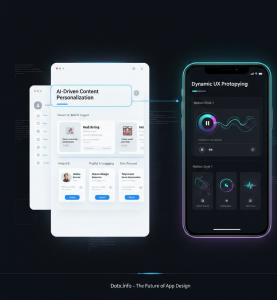
AI-Driven Content Personalization: Imagine a website whose layout, content blocks, and even calls-to-action dynamically adapt based on a user’s browsing history, demographics, or real-time behavior. Generative AI can analyze vast datasets to predict user preferences and generate personalized content, improving engagement and conversion rates.
Automated Layout & UI Generation: Instead of endless A/B testing, AI can suggest and even create multiple UI layouts based on performance metrics, user feedback, and design best practices. It can generate variations of buttons, forms, and entire page sections, allowing designers to focus on higher-level strategic thinking.
For Mobile Applications:
Dynamic UX Prototyping: Designers can input basic requirements or wireframes, and Generative AI can produce diverse UX design versions, complete with mock data and interactive elements. This dramatically speeds up the ideation and validation phases.
Optimized Motion Design & Animations: AI can analyze user interaction patterns and suggest or create fluid, engaging animations that enhance the user experience without feeling intrusive. This means more captivating transitions and micro-interactions that keep users engrossed.
Adaptive Interfaces: Mobile apps can use Generative AI to adapt their interface in real-time to user context – whether they’re driving, exercising, or relaxing, offering the most relevant information and functionality at that moment.
Here’s an example of AI assisting in the creation of varied UI elements:
2. Supercharging Development: Code, Speed & Efficiency
This is where the rubber meets the road. Generative AI is rapidly becoming a developer’s most powerful assistant, not a replacement.
For Web Applications:
AI-Powered Code Generation & Completion: Tools like GitHub Copilot (and similar internal frameworks) can suggest entire blocks of code, complete functions, or even generate boilerplates based on comments or existing code patterns. This significantly reduces development time and minimizes human error.
Automated Testing & Debugging: Generative AI can assist in creating comprehensive test cases, identifying edge cases that human testers might miss, and even suggesting fixes for detected bugs. It can analyze code for vulnerabilities and performance bottlenecks, making web apps more robust.
API & Microservice Generation: Based on defined schemas and requirements, AI can help scaffold APIs and microservices, speeding up backend development for complex web applications.
For Mobile Applications:
Low-Code/No-Code Platforms Enhanced by AI: While not purely Generative AI, the integration of AI into platforms like FlutterFlow (see video link below) allows users to describe desired features in natural language, and the AI generates the corresponding code or UI elements. This democratizes app development and enables rapid prototyping for both web and mobile.
Cross-Platform Code Optimization: AI can analyze code written for one platform (e.g., iOS) and suggest optimizations or refactors for another (e.g., Android), ensuring consistency and efficiency across your mobile ecosystem.
Automated Documentation: AI can automatically generate documentation from code comments, function definitions, and execution flows, saving developers valuable time and ensuring documentation is always up-to-date.
Consider this visual of AI assisting developers:

3. Enriching End-User Features & Engagement
This is perhaps the most visible and exciting impact for end-users. Generative AI is creating entirely new possibilities for interaction and service.
For Web Applications:
Advanced AI-Powered Chatbots & Virtual Assistants: Moving beyond rule-based bots, Generative AI enables chatbots that can understand complex queries, engage in natural language conversations, summarize information, generate creative content (e.g., draft emails for users), and provide highly personalized support or recommendations. These are indispensable for customer service, sales, and lead generation.
Dynamic Content Creation: For content-heavy web platforms (e.g., e-commerce, news portals), AI can generate product descriptions, marketing copy, or even summarize lengthy articles, keeping content fresh and tailored.
Intelligent Search & Discovery: Enhance search functions by allowing users to ask complex questions in natural language, receiving synthesized answers or curated content generated by AI, rather than just keyword matches.
For Mobile Applications:
Hyper-Personalized In-App Experiences: Beyond just recommending content, Generative AI can adapt the app’s entire flow, suggesting features, creating personalized greetings, or even generating customized mini-games or challenges based on user behavior and preferences.
Voice Recognition & Natural Language Interfaces: Improve upon existing voice commands by allowing for more conversational and contextual interactions. Users can simply speak their needs, and the app, powered by Generative AI, understands and acts upon them creatively.
Predictive Analytics for Proactive Assistance: An app could proactively offer solutions or information. For instance, a travel app might suggest alternative routes or activities based on real-time events and user preferences, generating new itinerary options on the fly.
Creative Content Generation (e.g., image filters, text effects): Mobile apps focused on creativity or social media can leverage Generative AI to offer unique filters, generate stickers, or create personalized avatars for users.
Imagine a user interacting with an intelligent, generative chatbot:

4. Addressing the Challenges: Ethical AI, Data Privacy & Security
No technological leap comes without its considerations. While Generative AI offers immense benefits, responsible implementation is paramount.
Key Challenges & How to Address Them:
Data Privacy & Compliance: Generative AI models often require vast amounts of data. Ensuring compliance with regulations like GDPR, CCPA, and emerging AI-specific acts (like the EU AI Act) is crucial. This involves careful data anonymization, consent management, and secure data handling practices.
Bias and Fairness: AI models can inherit biases present in their training data. Developers must actively work to identify and mitigate biases in Generative AI outputs to ensure fair and equitable experiences for all users. Regular audits and diverse training datasets are key.
Security of AI Models & APIs: Exposing AI model APIs (especially for Generative AI) introduces new attack vectors. Robust API security, authentication, authorization, and rate-limiting are essential to prevent misuse, data breaches, and model manipulation.
Explainability & Trust (XAI): While Generative AI is powerful, its “black box” nature can make it difficult to understand why it produced a particular output. Striving for explainable AI (XAI) where possible, and clearly communicating AI’s role to users, builds trust.
Responsible Use & Misinformation: The ability of Generative AI to create realistic but fabricated content necessitates careful consideration. Implementing safeguards against misinformation and misuse, especially in public-facing applications, is a moral and ethical obligation.
At dotx.info, we prioritize building AI solutions that are not only powerful but also ethical, secure, and compliant with global standards. We integrate privacy-by-design principles and robust security frameworks from the outset.
Getting Started: How dotx.info Can Help You Integrate Generative AI
The Generative AI landscape is evolving at lightning speed, and staying ahead requires expert guidance. At dotx.info, we specialize in helping businesses navigate this new frontier. Our services include:
AI Strategy Consulting: Identifying the most impactful Generative AI applications for your specific business goals.
Custom AI Model Development & Integration: Building and seamlessly integrating Generative AI features into your existing or new web and mobile applications.
Proof-of-Concept & Prototyping: Rapidly developing AI-powered prototypes to demonstrate feasibility and value.
Security & Compliance Audits: Ensuring your AI-driven apps meet the highest standards for data privacy and security.
The future of web and mobile apps is intelligent, personalized, and creatively augmented. Don’t be left behind.
Conclusion: Embrace the Generative Future
Generative AI is not just a tool; it’s a paradigm shift that will fundamentally alter how we conceive, build, and interact with web and mobile applications. From accelerating development timelines and cutting costs to delivering unparalleled personalized experiences, the benefits are profound.
The time to explore and implement Generative AI into your digital strategy is now. Partner with dotx.info to transform your next web or mobile app into a cutting-edge solution that truly stands out in the digital age.
Ready to revolutionize your app with Generative AI? Contact dotx.info today for a consultation!

