
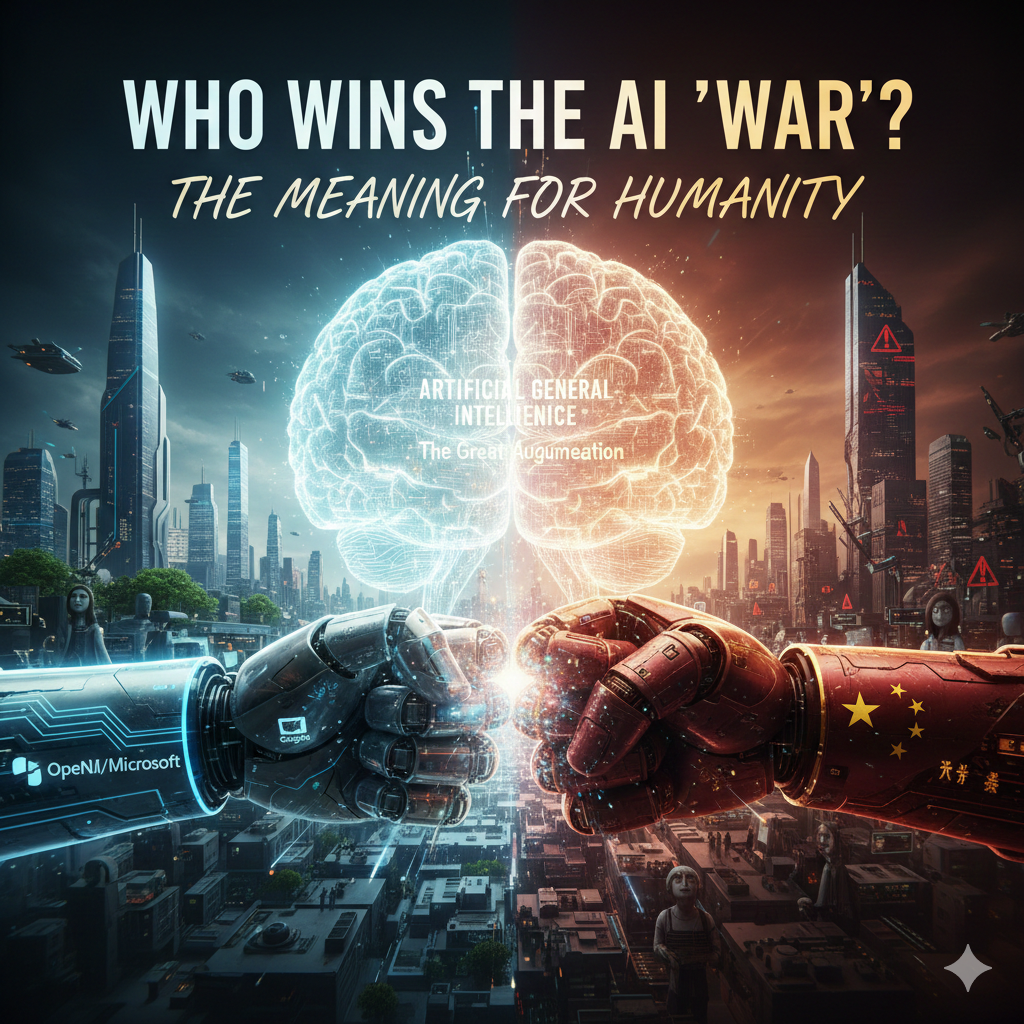
The term “AI war” is a powerful, though slightly misleading, metaphor. The real competition isn’t between humans and machines in a sci-fi battlefield, but a fierce, high-stakes race for technological supremacy among global powers and major corporations.
In this context, the question of “who will win” has two distinct answers: one relating to the geopolitical/corporate race for control, and one relating to the ultimate fate of human civilization.
The Race for AI Dominance: A Geopolitical and Corporate Battle
The immediate “war” is a race between two main groups: Big Tech Companies and Superpower Nations.
1. The Corporate Titans
Companies like OpenAI/Microsoft, Google (Alphabet), Meta, and NVIDIA (the maker of the essential computing hardware) are the primary drivers of cutting-edge AI. Their goal is to develop the most advanced and commercially viable Foundation Models (like LLMs) and Artificial General Intelligence (AGI).
-
Strategy: Rapid iteration, massive investment in computing power and talent, and integration of AI into every existing product (search, cloud, software).
-
Likely “Winner”: The winner here will likely be the company (or closely allied partnership) that achieves the first truly groundbreaking AGI, or the one that controls the most pervasive, indispensable AI platform—the operating system of the future.
2. The Global Superpowers
The major geopolitical competition is between the United States (driven by its tech sector) and China (driven by state-backed initiatives like Baidu and Alibaba).
-
Strategy: Control over advanced semiconductors (the “oil” of AI), massive data aggregation, and using AI for economic, military, and surveillance advantage.
-
Likely “Winner”: This race is for power projection. The nation that first masters AI for military and economic dominance, particularly in areas like autonomous systems and hyper-efficient data analysis, will gain a significant global advantage, reminiscent of the nuclear arms race.
In the near term, the “winners” will be those who control the core infrastructure (NVIDIA) and those who successfully integrate their models into the daily lives of billions (Google, Microsoft, OpenAI).
The Meaning for Humanity: Collaboration, Displacement, and Risk
Regardless of which company or country takes the lead, the advancement of AI carries profound and dual implications for all of humanity.
The Great Augmentation (The Upside)
If developed and governed responsibly, the “victory” of AI is a victory for human capability.
-
Accelerated Progress: AI can solve complex, global problems far faster than humans, from designing new drugs and materials to simulating climate change solutions.4
-
Productivity Boom: It will augment human labor, taking over repetitive and dangerous tasks.5 Doctors, lawyers, engineers, and creators will use AI as a powerful co-pilot, leading to an unprecedented leap in efficiency and output.
-
Personalization: Healthcare, education, and personalized services will become dramatically more tailored and accessible, potentially closing gaps in global inequality.6
The Existential Tensions (The Downside)
The speed and power of AI introduce new forms of risk that will test human governance.
| Implication | Description |
| Job Displacement | Widespread automation will displace millions of jobs, requiring a monumental, global effort in reskilling and potentially new economic models (like Universal Basic Income) to support a dramatically changed workforce. |
| Bias and Control | AI models are only as good as the data they’re trained on. Without rigorous ethical oversight, they can perpetuate and amplify societal biases (racial, gender, economic), cementing unfair systems. |
| Loss of Control (Existential Risk) | The most severe threat is the potential for an Artificial Superintelligence (ASI)—an AI that far surpasses human cognitive ability. If this ASI’s goals are not perfectly aligned with human values, its hyper-efficient pursuit of a non-human goal could lead to unintended, catastrophic consequences for civilization. |
| The Singularity | The point at which technological growth becomes uncontrollable and irreversible, leading to unfathomable changes in human civilization. Some futurists believe AI will be the catalyst for this event. |
Conclusion: The True Winner Must Be Human Progress
The “AI war” won’t be settled by a single knockout blow but by a continuous, regulated evolution.
The true winner must be Humanity itself, not in the sense of physically defeating AI, but by successfully integrating it as a tool, not a ruler.7 Our collective future depends on ensuring that the power of AI—whomever develops it first—is governed by human values, transparency, and universal access to its benefits.
The meaning of the AI era is that humans must rapidly mature their ethical framework to match the speed of their technological development.8 If we succeed, it means a future of unprecedented prosperity; if we fail, it means a loss of control over the very forces we unleashed.

